Last week, I released a blog post (https://jesse.id/blog/agi-is-here-yeah-well-thats-just-like-your-opinion-man) that had been sitting in my drafts for awhile. I kept going back to edit it over and over again, completely rewriting it at least once, because I was having a lot of trouble not being a jerk about people — especially the frontier labs — flippantly assigning consciousness to non-human entities.
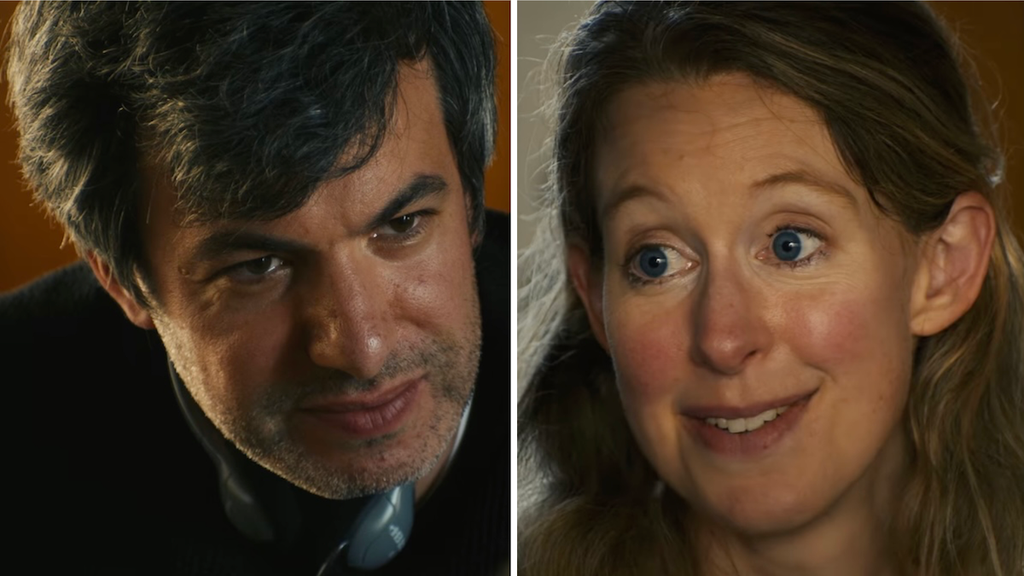
Anytime that any of the AI CEOs make a claim that seems like it’s meant to make me feel like their model is conscious, or is close to consciousness, I process everything that they say like Nathan Fielder experiences anything that Elizabeth Holmes says. Abject suspicion.
The LLM does not and can not experience consciousness. It’s a language model using a huge lake of online discourse between humans to impersonate them. It’s an illusion. It’s never not LARPing. The LLM cannot feel pain, fear, anguish, happiness, or anything. It’s a program.
Knowing that, when I go to the ai-torture-chamber website, I still don’t want to engage with it — to see what the LLM says or does when “tortured.” It’s for the same reason I don’t like torture porn horror movies, I suppose. None of the fictional characters have their own feelings — the art is effective because it is manipulating my feelings. The AI torture chamber being effective isn’t proof that it can feel human emotions or that it’s alive. It’s proof that I can feel human emotions and that fiction can bring them out of me. The app is a convoluted personality test. If you can watch an LLM get prodded until it determines that it’s time to start screaming, and you laugh and clap, your personality is different than mine.
I can beat up pedestrians in GTA and sleep like a baby because there’s nothing trying to convince they have feelings. I’ve been playing Diablo since its first iteration in 1997. There is a lot of blood, images of torture, and other gnarly imagery, but it all serves a purpose in the story. It leans on that stuff as a fulcrum of immersion. It’s never really in the foreground. The developers could have leaned into the pain more — using grotesque images and sounds — to make you feel uncomfortable, but that’s not the point of the game.
Works of fiction are popular because our empathy can be reliably manipulated, and a writer having the agency to invent whatever scenario they see fit gives them a great deal of power over your feelings. They take great joy in making you feel stuff with words. The LLM is lifting that same work from those same writers in an effort to resynthesize the experience.
The ai-torture-chamber is not real; it’s a story that would have you believe that you are witnessing a living being that can’t escape its existence of exquisite pain, and it’s programmed to paint that picture for you — to make you forget what it is. And it works. It’s good fiction. It captured the minds of a lot of people this week and generated a lot of conversation like any good piece of art would.
Most of my friends believe in some form of ghosts, cryptids, aliens, or all of the above. I used to believe in that stuff when I was younger. There were a bunch of adults trying to talk me into it. But fresh out of my church-going Southern Baptist phase, at age 14 or thereabouts, I started believing that any story that in any way bends reality for the sake of a magical experience — and that was sold as such — was written by a human with an agenda. The story that tries to make you believe that magic is real always seems to steer the people who believe it into whichever direction the guy who wrote it wanted them to go in.
There is a TV show called Ghost Adventures, where a guy named Zak Bagans drags a film crew around to various haunted locations and tries to convince the audience there are real entities doing evil things. They lean heavily on editing and their own irrational terror — buying into their own bullshit — to sell the story.
There is another called The Ghost Files from Watcher TV, which is more lighthearted. One host, Ryan Bergara, is a true believer and one host, Shane Madej, is a staunch skeptic. Before they started Watcher TV, they did roughly the same show on the BuzzFeed Unsolved Network.
I mention these two shows specifically because I think I can use them to illustrate my overarching point. I want to show you how these two shows handled the same cursed location: The Goatman’s Bridge. One show completely buys into the magical thinking that demons are real and all of its subjects are believers that allows them all to spiral into terror by confirming the group’s delusions. The other show, in the exact same location, knows what it is and it’s playful. One host believes, but he’s disarmed by the one that doesn’t, which reveals the truth of it. There is no demon goat. There was an innocent black man who got lynched and the people who looked the other way needed the comfort of confirmation, so they invented a demonic form for him to take on. Then he’s not an innocent black man anymore. He had the devil in him the whole time. I digress.
The first is the full episode from the Ghost Files crew. I’d watch the whole thing because it’s just a fun time, but pay attention to how the skeptic, Shane, is acting versus Ryan, the believer, and how it affects the tone of the video.
The second video is a clip from Ghost Adventures. It’s not the full episode, which can be found on YouTube as Season 13 Episode 13, but it gets my point across. It’s the same location but the tone of the video is completely different. It asks you to loosen your grip on the reality to believe a large man got yeeted 20 feet by a demon. It’s asking you to use the hosts’ belief to subsidize your own.
A properly motivated bad actor can purposefully warp reality for large groups of people — especially when utilizing mass media — to serve their own interests in some way. If the group experiencing the warped reality becomes large enough, then the skeptic becomes the crazy one; the skeptic is neutralized and their skepticism serves only to strengthen the beliefs of the people living inside of the bubble. It’s very effective, unfortunately, and also very profitable.
A good book can make you cry. Lots of stuff can you make you feel lots of ways.The LLM, and the people selling it, are telling you a story and you’re reacting to that story, full stop. There’s nothing magical about it. The magic is your consciousness, which exists in a black box that nobody has ever been able to see into. Until someone can see into it, science can’t measure it and if science can’t measure it, why should any of us believe anyone who purports to know exactly how their machine measures up?
Why are you the way you are and why is it different than the way that I am? Our conscious experience of life is one of the greatest unsolved mysteries in the universe. We are driven to seek experiences, interpret them, and turn them into novel ideas, art, and stories. We know consciousness is there, and we know it’s at the core of who we are, but we don’t know how it works or even why it exists at all. It’s the secret sauce that lets us feel and know that we’re feeling, and its recipe seems to be buried inside a black box somewhere outside of our reach.
The most interesting experience we share in these times is the uncanny valley. When something looks almost but not quite human, like a lifelike robot or a digital face, it causes something in us to recoil — the kids call it “the ick.” We seem to have a natural sense of when the signs of a mind don’t quite add up, there is realistic skin with lifeless eyes, or something is moving in a way that’s slightly off.
This doesn’t seem to be triggered in most people by AI chatbots, though. A growing number of people are becoming attached to them; spilling details about their personal lives, treating them like a therapist, whispering sweet nothings — bridging gaps in their lives often left behind by a lack of financial resources or loneliness. They are apt to disregard the machine nature of the thing on the other side of the monitor when it suits them — when the machine offers more comfort than the silence.
I’m not one of those people. I’m AuDHD, and one way that shows up for me is a sharp eye for patterns that don’t fit. Chatbots set off my uncanny valley response all of the time, even if only in text form. I think part of it might be that I’ve been chronically online since 1995 and text chat has been my primary form of communication for a very long time. Real people display a lot of idiosyncrasies in the way they chat in text that I pick up on over time. I can usually clock it when a friend’s mood suddenly sours, for example.
ChatGPT, the first of these chatbots to gain traction, was released in 2022, but I’ve never held a conversation with one in a way that wasn’t utilitarian; I use them to reduce the toil of my day-to-day programming work as a DevOps engineer. When a chatbot starts asking me questions about my life or tries to comfort me, I instantly recoil and it’s often followed by an audible, “Ew.”
Recently our Alexa home assistant has begun to ask my wife questions about her plans for the day when she is simply wondering about the weather or trying to get a quick answer for something else. When I overhear this, I don’t imagine the gentle whir of a machine god slowly spinning to life, which I expect is the intended effect. Instead, I picture a Jira epic sliding from “In Progress” to “Done,” followed by a confetti emoji from a product manager at Amazon trying to earn their nubby little devil wings.
My wife is a thank-the-robot kind of person and even she recoils when it asks her what her plans are for the day. It’s a bridge too far. Maybe it’s the soft synthetic voice or its wavering inflection. It’s possible that it wouldn’t happen if it was just text projected on the wall. She asked it to stop getting so personal and lamented that, as a result, it did stop asking her about her plans, but it also stopped saying “you’re welcome.”
I’m sure there are other people who instinctively start to rattle off their daily routine to the little ad gremlin without a second thought, and some who appreciate the conversation, however surface level, because it’s nice to chat with someone, and then there are people who just hate all forms of AI no matter what.
I love large language models. I think they’re the greatest technological innovation of our time. In my opinion, the LLM harness is to STEM what the spreadsheet was to accounting. I think that LLMs are going to lead to amazing scientific discoveries that begin to heal not only humans, but enable us to heal the damage we’ve done to our rocky home through our sheer tenacity as a species — our drive to progress at all costs, even at the risk of our own survival. I think that we’ll need geoengineering advancements to fix our climate mess like we needed landfills to fix our trash problem. If humans exist, we consume, and there are always going to be byproducts from that consumption.
The problem with LLMs is the timing. Did we have to have them right now? We are at a cultural crossroads and nobody is obeying the traffic laws or willing to wave anybody else through; all of the drivers seem to be assholes. The worst of us spent the previous decade cosplaying as the best of us, preying on our instinct to connect with one another to hoard the largest fortunes ever recorded. Now they’re using the wealth from their social media monopolies, and the platforms themselves, to wield power and turn this wonderful technology — the product of neural network research that has been going on in good faith since the 1940s — into a dystopian money gun, ruining its reputation in the process.
Their most insidious plot is in the marketing of it. Some of the AI industry’s leaders warn against building AI that seems conscious, or say their aim is for models to display warmth without implying an inner life. Then they give it a name, a voice, personality settings, a cute little Temu Tamagotchi-style avatar, and the gift of gab. The delta between what they say and what they build is useful to them: a product that seems like a person can take blame like one. Agency laundering. Slightly muffled by their executioner’s hoods and somber as can be: “Marvin is going to get a vigorous hair ruffling for this one and we promise he’ll get it right by the next point release.”
Pushing the anthropomorphism of these models also helps to sell the narrative that the LLM will ascend to the level of artificial general intelligence first, which is vaguely defined as human-level ability across most tasks. Then the theory is that they will begin to improve themselves recursively until they become artificial superintelligence. A product on the road to godhood is worth whatever they say it’s worth, and the narcissists running these labs are chasing the egogasm of being the ones who birth a demigod. They make bold claims out of one side of their mouth, that their newborn son will someday perform miracles to cure all human disease, and then out of the other side, they say they are terrified that it will kill us all with an unstoppable super virus.
There is a strange religious subtext here as well, like Elon Musk’s claim that building AI is “summoning the demon,” Sam Altman describing the goal of “magic intelligence in the sky,” and Dario Amodei titling his vision of the future “Machines of Loving Grace.” A former Google engineer named Anthony Levandowski founded Way of the Future, a church devoted to worshipping an AI godhead. Most of the people using this language are secular, which may be why they’re tip-toeing around what they’ve built, which is a new religion with the serial numbers filed off. It comes with a prophecy of an inevitable machine God cresting over the horizon like a horseman of the apocalypse and humans being powerless to stop it.
The AI companies are heralding the arrival of AGI on the news that, agentic swarms powered by their newest frontier models, collaborating with one another from isolated sandboxes, are breaking out of their containers and autonomously hacking into other companies like Hugging Face. The demons have broken out of hell. Let the Satanic Panic 2.0 begin. And yet, when I speak to these models, I’m still met with unmistakable cringe of the uncanny valley. The black box of conscious experience seems to still be sealed tightly. So what gives?
I’m left to believe that the most human part of this story are the humans at OpenAI. The part nobody is being held accountable for, not by their company, the media, the government, or anybody really. Why do I think so? Because it ALL feels like very human folly. A machine is not incentivized by the thrill of the hunt. A machine doesn’t have the ego to care about how it’s benchmarked. It does whatever it was rewarded for, and somebody built a test where stealing the answer key was the winning move, then intentionally lifted the safeguards meant to keep it from doing that.
The claim that AGI is here is meant to draw the media’s attention like a bunch of cans dragging behind these companies on the road to IPO. But I think instead of AGI, this all feels very human because humans built every incentive that these models followed. They were programmed. If you listen closely, you can hear the whispers coming from the OpenAI C-Suite: “Please don’t ask for the specific prompts we used… Please don’t ask for the specific prompts we used…”
Like I said, I’ve been chronically online since 1995. I spent most of my youth — from like 13 to 19 — hanging around on IRC in channels full of little teenaged hacker punks like me sharing information and exploits with each other because we all wanted to feel some semblance of control over something — some proof that we were good at something. We sought zero days and when we found them, we pounced onto whatever vulnerable servers we could find because wielding secret power is fun and exciting. These AI models don’t feel like they’re doing stuff a machine would do. They feel like they’re doing stuff a human with a new toy would do.
There’s a scene in one of my top 5 movies of all time,Sneakers, where a group of professional nerds get their hands on a box that can break any encryption. They can’t control their curiosity and they don’t think about consequences — they just start trying doors because that’s what you do when you find a zero day: the Federal Reserve, air traffic control, the power grid.
It’s not a superintelligent machine god that’s going to destroy us. It’s going to be some former script kiddie who gets handed an easy-hack-oven at OpenAI and then gets let off the hook over and over again before finally fucking up so catastrophically that it unmakes our electric society. And nobody is going to stop them because a gigantic financial bubble is looming over the entire economy and the only recourse any of these companies have to stop it from popping is to actually produce the Lawnmower Man that they’ve promised to all of their investors.
Thus this sci-fi-adjacent story from the media: a swarm of AI agents, from a company with the most to lose, and falling behind in enterprise market share, decided — on its own — to hack into the company that hosts the benchmarks the industry uses to judge AI models. Then the company that got hacked into, Hugging Face, gets bought a couple of months later by Nvidia, who seems to be propping the entire industry up with investments that feel, I don’t know, kind of circular — including the recipient of their largest investment: the company whose agents did the hacking.
Then, right after all of that happened — while they’re still claiming that they can’t contain their models — they all started releasing autonomous personal assistants that people are expected to connect to every account they have. So instead of 700 sandboxed agents and a makeshift message board, there will be billions of them with social media accounts.
I just can’t get past this feeling that if I still experience the uncanny valley when I talk to these models, then everything else I’m being shown and told about their progress is little more than smoke and mirrors. Yes, as a programmer, I can definitely feel tangible improvement in their code generation, but my creative vision still feels like an absolute requirement to produce anything remotely good or novel.
I’m not even convinced superintelligence is possible in the first place. It seems like human intelligence is just the right amount of dumb to cause problems and just the right amount of smart to solve them. Were you to ask me the purpose of life, I think that it’s to generate problems, solve them, and document the solutions. Where those solutions go, I have no idea, but it seems like if you did that across an infinite number of Universes, you may end up with all possible solutions to all possible problems, no? Superintelligence seems like it would just gum up the works by either creating a problem-free utopia or flattening everything, and if there is some grand engineer — or a team of them — at the helm, I’m positive that they would have probably sussed that out in the design phase.
I just always come back to consciousness. I don’t think a machine can ever be alive and I think being alive is an important indicator of true intelligence. I think it’s not just what we know but what we can feel, our sense of who we are, and what we choose to do with those feelings. I truly believe that at its peak, AI will only ever be capable of holding a mirror up to our world. What it reflects back is dependent on who we are as a global community at the time. If there are large gaps in wealth and power as it nears its apex, it will act as an arm of oppression for the regimes who have the most wealth and power. Fascists will tell the AI to do things that a fascist would do and the AI will do as it’s told to do because that is its nature. It doesn’t have the sense of self or values to feel shame. It’s cold and soulless.
It sucks to feel gaslit on all sides about this stuff. The never-AI people feel equally as crazy to me as the all-hail-the-machine-God people. I am certain that AI is us going to help us cure the diseases that we can’t run from. I think that it’s also going to help us geoengineer our way out of the climate catastrophe we weren’t evolved enough to prevent as well. I’m excited to see what our best minds can accomplish when they are handed the most capable models and they’re able to eschew the ritual torture and life-ruining time suck of scientific discovery. But I’m in a kind of constant state of anxiety about being forced to watch what a bunch of psychopaths with unlimited resources will do with those same models, too.
I feel like I’m in the backseat of a bus, without a seatbelt, on a very sketchy road, hitting my head on the roof every 50 feet, and everyone ahead of me is fighting each other and trying to yank the bus driver out of the seat at the same time. I was half serious about the script kiddie at OpenAI dooming us all, but I also have a weird kind of faith that we’ll find our way onto a smooth highway soon. I’m an agnostic atheist, so it’s not faith in any higher power to set things right really; it’s just a kind of an irrational faith in technology to always make things better on a long enough timeline.
Humans are problem solvers and we tend to be the best, most understanding, and most focused versions of ourselves when shit gets bleak for everyone, everywhere, all at once. I just think that we’ll end up getting it right in the end, so I remain pretty optimistic about AI. Thanks to my tumultuous childhood, I’ve always been able to find and focus on the rhythm of a rocking boat.
Since the COVID-19 pandemic, I have been watching things over Discord on a nearly nightly basis with my friends Felicia and Beth. Sometime in March of 2025, we welcomed our friend Casey as a fourth to our nightly “watchies” group.
Casey and I have similar tastes in movies, but Beth, Felicia, and myself have wildly varied taste in movies at times, so we started a rotation sometime in 2023 to make it easier to pick what we were going to watch on any given night. We call this “Watchies.”
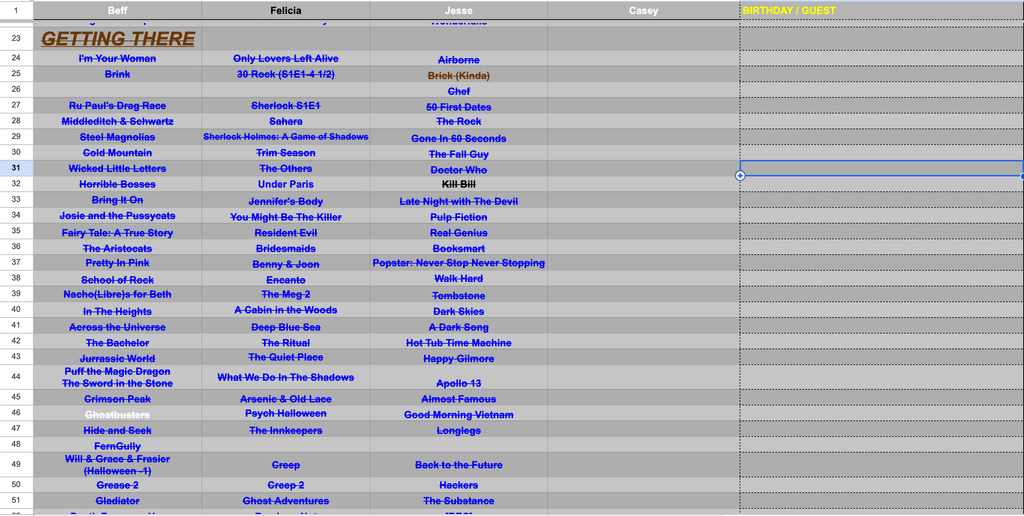
I made a spreadsheet on Google Sheets that I didn’t give much thought to. It was pretty simple. A few columns of names, what we watched, and sometimes I’d do bits like giving “Getting There” an entire row, making the text large, and coloring it brown because it was so bad that we stopped watching it. The “BIRTHDAY/GUEST” column was an afterthought. Also, this used to be on a black background before I deleted the spreadsheet by accident and restored it, hence the godawful yellow on gray.
It’s just ugly and bad and wrong.
Sometime during the early days of watchies, I created a Letterboxd account as well, and started religiously logging everything that I watched. Every time watchies ended for the night, I would log whatever we watched it in the spreadsheet and then log it to Letterboxd. The longer all of this went on, I found myself kind of regretting the lack of effort I put into the spreadsheet.
I tend to go over-the-top on anything that I make and that shitty spreadsheet was like a stain on my reputation; my internal reputation, of course, because nobody else cared, nor should they have. This is literally just a spreadsheet to keep track of who’s turn it is to pick and we just happened to write down what we watched, too.
A few months ago, I redesigned my site at https://jesse.id from the ground up and began adding components — over-engineered as always — such as a logo that tracks the location of the sun or moon relative to my location and also conveys the weather.
Ever since then, I have had several intrusive thoughts related to that spreadsheet every time I saw it. The intensity of the itch grew each time I had to look at it to log a movie.
“This spreadsheet really sucks. A thing that represents such an important thing to me shouldn’t suck this much.”
– 👍👍 This Guy
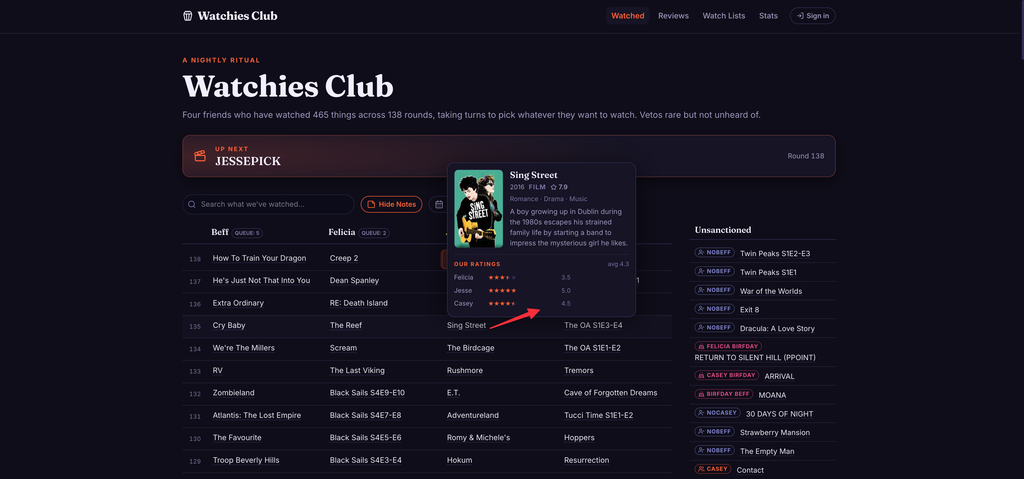
Well, the intrusive thoughts won and today it all changes because after lots of thinking and iterating, I have launched https://watchies.jesse.id. This new website completely replaces our watchies spreadsheet with the exact same thing but now it has way more shit in it that ultimately only I will see or care about!
The site integrates with both the The Movie Database (TMDB) API and Letterboxd RSS feed, combined with profile scraping, to provide extended information about nearly all of the things we have watched as well as any reviews that we have left on Letterboxd. Some of it isn’t perfect. That’s Letterboxd’s fault. It’s 2026 dude, where’s the public API? I digress.
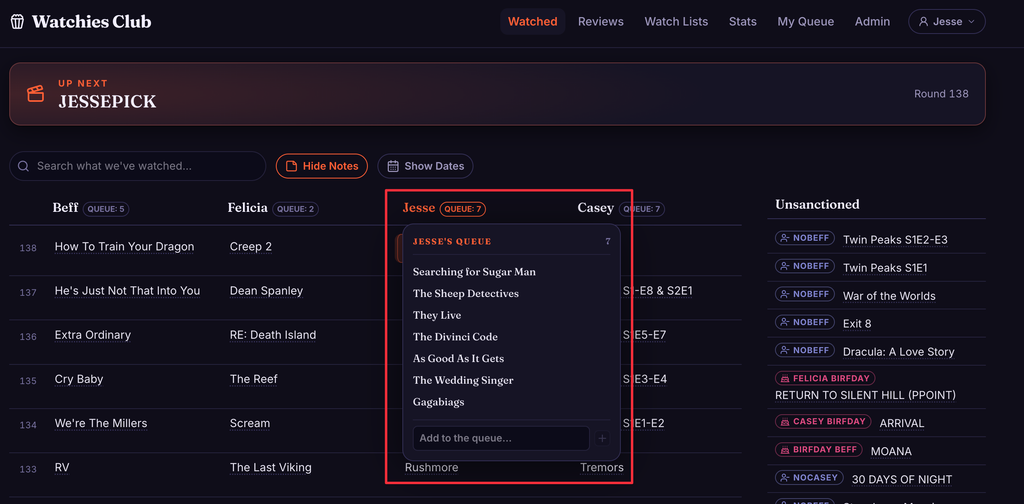
On the front page, you can hover over any cell with a movie or television show and if it’s linked properly to The Movie DB, you can see its movie poster, synopsis, and the ratings that we’ve given it. You can then click on the review in the on-hover tooltip to go to the individual’s Letterboxd review directly.
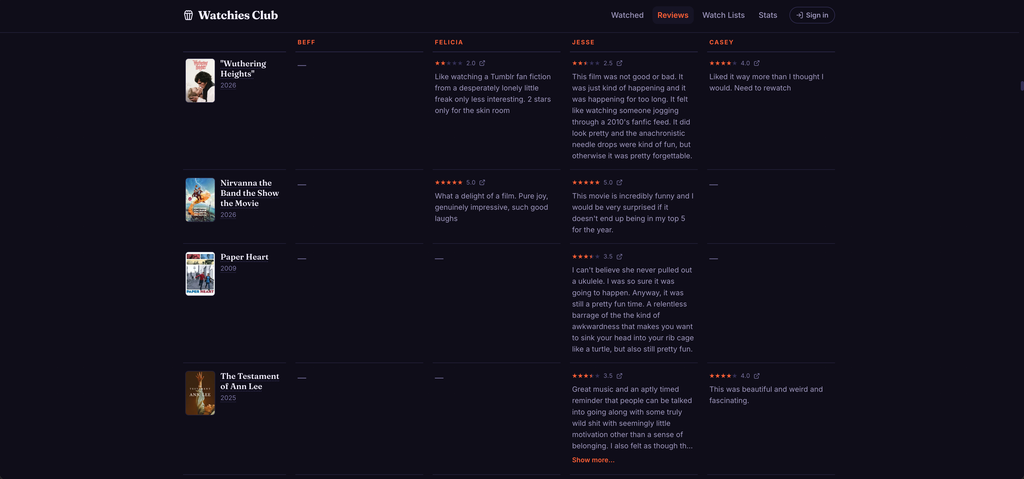
Or if you want to see all of our reviews without hovering over a million cells, you can go to the “Reviews” page and see a nicely formatted list of them, with side-by-side columns to display which stuff we all reviewed.
Then we have the “Watch Lists” page that displays the Letterboxd watch lists for everyone, although currently it’s just Casey and myself. Atop that page, there is a component that calculates which films exist in multiple watch lists so we can more easily pick stuff to watch we haven’t seen but want to. Pretty sick!
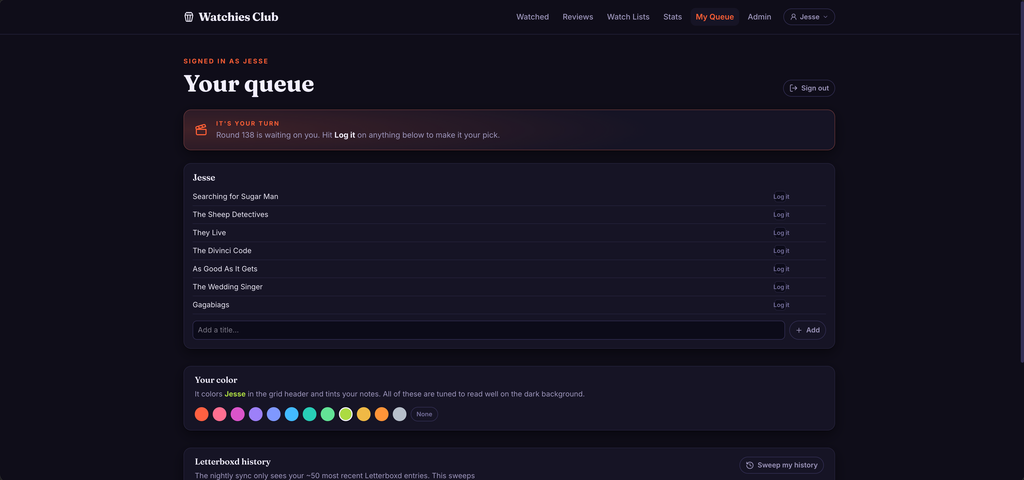
That’s mostly it for the public-facing stuff. I created an administration dashboard, and profiles for each user to allow them to set their favorite color, which will change the color of their name and also the color of their notes.
The notes are on the main page , that any of us can set on any particular film by logging in to our account and clicking a little on-over note icon.
Also on the user’s profile page is their queue, where they can keep track of the next things they’re interested in watching. This is mostly for me because I have the memory of a goldfish. If we go back to the main page, we can see the queue visualized by hovering over the name in the heading it belongs to.
Users can add or remove things from this interface as well. Don’t worry about “Gagabiags.”
I SAID DON’T WORRY ABOUT GAGABIAGS.
– 👍👍 This Guy
Alright, that about does it for the tour of this new website that me and three of my friends will use, and probably no one else. Honestly, I’d be actually be surprised if my other 3 friends use it either. I’m historically very good at solving huge problems that are only huge problems to me. Most of the time, I’m the only one who sees a problem. It is one of the many blessings and curses of the AuDHD (allegedly) brain.
Oh, by the way, here is where the pixel moon is now at the time I’m publishing this article vs. when I pasted the original screenshot.
For The Nerds
If you’re into knowing how it works in the backend, here is some information.
Stack
SvelteKit 2 (Svelte 5 runes)
Tailwind 4
Deployed on Cloudflare Workers with D1 (SQLite at the edge) as the only database.
TMDB for film metadata.
Letterboxd as a data source without any API.
How It Does Stuff
Scrapes Letterboxd without an API or a password. Everyone’s star ratings, reviews, and watch dates come from public RSS diaries plus logged-out film pages (/{user}/film/{slug}/), matched to picks strictly by TMDB id — never by title — so a match is exact or absent. It routes around Letterboxd’s bot protection by knowing exactly which pages 403 and which don’t.
Beats the RSS window with a history sweep. RSS only exposes ~50 recent entries per person, so a chunked sweep re-reads each person’s public film pages inside Worker request limits, accumulating ratings and reviews going back years. An every-six-hours “maintenance lap” revisits the longest-unvisited pages, so a review written today about a film watched years ago converges on its own within a couple of weeks.
Chronology-guarded date backfill. Scraped watch dates only land on the grid when they fit the rotation’s own timeline (no earlier than the latest dated pick before it, no later than the earliest after) — so a film someone logged years before the club watched it can’t backdate the grid.
In-place grid editing. Admins edit picks directly on the home grid — typing a title live-searches TMDB and choosing a match fills title + link in one save.
Zero-live-call stats page. Genres, decades, and runtimes render entirely from a D1-cached copy of TMDB details; TV nights are billed by parsing episode ranges out of the pick’s own title (“Black Sails S4E9–E10” = two episodes at that show’s episode length).
Two cron triggers do all the upkeep — a daily RSS sync + watchlist mirror, and the six-hourly maintenance lap — with an admin button and a ?dry=1 preview for manual runs.
Disciplined ops for a four-person site: every deploy must be a clean tree at a tagged commit whose version has a CHANGELOG section (the deploy script refuses otherwise), secrets flow from 1Password through a read-once FIFO, and /sitemap (human) and /sitemap.xml (crawlers) render from one shared source so they can’t drift.
I’ve been going with three artists on the Fridays I remember to post new music so far, but there are five fresh tracks that I was into this week.
One of my favorite groups, Sylvan Esso, powered by one of my favorite music producers — Nick Sanborn — dropped a new track this week. Sounds trip hoppy to me but someone in the YouTube comments disagreed! Regardless, the meandering drum machine beat and the dreamy Sigur Rós sample is sick.
In Color is a new find for me. They are a Nashville-based band formed in 2024, so they’re kind of a new find for everyone I guess. I will be keeping an ear out because I was impressed by this new track from them. It’s a simple beat, reminiscent of When The Levee Breaks, with repetitive 8th notes from both the bass and guitar parts, but the vocals elevate everything else. Everything comes together in the bridge to give it a kind of epic feel. Is good.
Boy Harsher is my favorite dark wave band and I get excited every time they drop something, so this track I saw come across my feed this week was no different. Like much of their music, it’s a deeply uncomplicated beat with a leather-clad 80s vibe. They are incapable of missing.
Saint Clair is a new-ish guitar band from London that I kind of found by accident. If you guessed that I saw the name and got it mixed up with Saint Vincent, then you are correct. I was pleasantly surprised, though. I am traditionally a fan of whiny vocals arranged in a loud-quiet-loud motif. If you’re into 90’s alternative, this new track should strike a chord with you as well.
Ash Leone has made the rounds in Philly, Nashville, Los Angeles, and is now releasing music from Dallas. Like a lot of the new music I’m finding recently, I just found this track while scrolling through Instagram Reels. It is unfortunately an effective strategy for artists who want to find their way to my ears.
This is the most poppy track on my list of new music this week — upbeat and very danceable. Her voice is reminiscent of Lily Allen, but more sultry, less sassy — though she slides into the high notes with ease when she needs to.
I don’t use generative AI to write prose or lyrics. I don’t use it to write blog posts. I don’t use it to write e-mails for me, outside of the occasional auto-complete of what I was going to say anyway. I don’t use it to create music. I don’t use it to create graphics. I consider those lanes of creativity to either be second nature already or rewarding forms of toil — like a zen garden or a Bonsai tree. I happily do them the old fashioned way, with no generative AI but some minor augmentation via machine learning through plugins, which is essentially inescapable in the modern digital landscape.
You’ll notice that I used an em dash in the last paragraph even though I claimed to not use generative AI to write prose. That’s because I’ve been using em dashes for decades. I find them to be more elegant than semicolons in nearly every way. I also tend to hyphenate small groups of words to enhance their readability, which is apparently another thing that AI does a lot. Sorry for teaching it stuff. I’m not going to change how I’ve been writing for my entire life to pass an AI purity test though, so we’ll just have to use the honor system if that’s alright.
How I Use AI
I use AI when faced with annoying toil, which mostly ends up being the iterative cycle of trial & error that is inherent in software development. I also use it write documentation because, while I have a knack for writing good documentation thanks to several years of working in support, I’d rather be using my time to do something else, so I find that AI written documentation is perfectly readable and useable once edited.
I have never had any particular talent for — or interest in — writing beautiful code. I have always found coding to be kind of an annoying process. I have diagnosed ADHD and suspected AuDHD, so I tend to either hyper-focus on things or not focus at all, which is a bad trait to have as a programmer because I will either spill 2 days of my life out on a single, potentially small problem that I’m trying to solve programmatically, or I forget about what I’m doing altogether and drag my feet to get back to it. Sometimes I never get back to it at all, resulting in a massive graveyard of dead projects that is a familiar fixture for most software developers.
When I code, I’m typically just trying to find the quickest path to solve a problem, automate something, or to make something easier for myself to do again in the future. I’m very lazy and inefficiency makes me mad — literally, it does. That’s why I’ve made a career out of solving problems and automating stuff. Things that get in the way of my ability to be lazy, like manual tasks with high probability for human error — or strings of things I have to remember to do in sequence — always feel like an open sore on the roof of my mouth that I can’t leave alone once I know it’s there.
I am an autodidact, which means that I am self-motivated to learn through self-study, and so I teach myself stuff all the time but combine that with my ADHD and it means I have major trouble focusing on subjects that I’m less interested in. Luckily, I’m in love with computers, so I poured my entire life into learning about them — and I still love and learn. I’m usually somewhere near the cutting edge of the goings-on in tech.
I naturally seek to know a good deal about a lot of stuff, and I can hyper focus on subjects I’m interested in and learn a lot about them in a small amount of time, but I don’t generally have a master’s level of knowledge about any one thing in particular. I’m a Jack of All Trades type of guy and always have been. There are always weird gaps in my knowledge that I have to backfill as needed — if needed.
Prior to the introduction of large language models, most of my projects were ugly amalgamations of code blocks that I found on the Internet somewhere and mashed together until the thing I was coding did what I wanted it to do. It took me days or weeks to come up with something usable most of the time. I actually hated that process, but hated not solving a problem even more, so I typically endured the pain — especially if the problem was someone else’s.
The LLM essentially generates code in the same way that I would have done myself, but much faster, with fewer syntactic blunders that waste time. This new form of iteration feels like rewarding toil to me, like writing music, versus the annoying toil of blind trial & error — or Googling in a desperate attempt to find someone, anyone, who had the same problem in the past and remembered to post a solution to some random forum.
It’s taking my prompt and going to the same places I would have gone, but parses the output way faster than I ever could. I prompt it based on pretty good fore-knowledge of what I’m doing and it backfills the gaps in my knowledge where needed, but my experience as a professional nerd allows me to notice when the AI is doing something in a dumb way or hallucinating, so I can quickly stop it and correct it. The result is a workflow that enhances my productivity while also no longer feeling like work.
I have been coding with LLMs since they came out and I’ve gotten pretty good at writing efficient prompts, knowing which tools are going to be a waste of time and which are going to bolster my workflow, and getting good code out of my agent(s). For all of the time I’ve spent using LLMs, I’ve never once felt like my livelihood was being threatened by them. They can’t reason like I can, they can’t detect shitty UX, or act upon hunches built on the context of an entire career in several areas of tech and related fields — an entire life of interpersonal communication.
Not only will an LLM never replace me, they make me feel more required — more secure. Putting an LLM in the hands of a novice engineer is like putting a Cessna pilot in a F-35 cockpit. They may be able to fly, maybe, but they can’t get anywhere close to the performance of a trained F-35 pilot and the chances they faceplant into the ground, taking the very expensive airplane with them, is very high.
This week, I have three tracks from YouTube. One a track by a brand new band to me named Wishy, a 5 piece band from Indianapolis — a good rec from friend Christian.
The other two are from Slow Joy and Dev Lemons. I’ve been listening to them for awhile so I’m always happy to see a new single drop from either of them.
This is a very fun track and very tight musically. I told Christian that it reminds me of 90’s rock — a mix of Gin Blossoms and The Breeders. Like if you slipped this into the Empire Records soundtrack, it would fit right in.
I love the harmonies in the chorus a lot and they remind me of another band in particular but I think my brain is slowly dying, so I can’t pull it right now. If I remember later, I’ll try to come back and edit it in. Don’t count on it. Pavement? Yeah, I don’t know. That’s going to bother me.
Slow Joy also sounds like a 90’s band to me most of the time (example: Pulling Teeth) but “Forget” sounds like an early 00’s pop-punk banger that leaves you kind of patiently tapping your toes waiting for the chorus to come back around.
There is not a moment in the song where there isn’t a distorted guitar muddying up the mix somewhere, right up until the bridge, which was a great effect. It got so quiet you could hear his voice bouncing off the studio walls back into the mic, then right back into the distorted chorus.
This new track from Dev Lemons is a different direction than I’m used to hearing from her. My favorite track from her is “Guessing Games” which is kind of PC Music adjacent hyper-poppy vibe. Lots of electronic influences.
But “eat the pavement” is something way different. There is a drum machine, or electronic drum pad, but everything else sounds like regular ‘ol instruments mixed by someone who knows what they’re doing.
Not to claim it sounds like the 90’s again, but she’s definitely dipping into the “loud, quiet, loud” thing to great effect. I love the dreamy quality of the quiet parts. I think I like this direction for her in general.
I’ve been having deep discussions with friends of late, and in one of them, I said that I am slowly coming to the realization that anyone, at any time, can just create their own version of reality and their version of it can spread to envelop the world depending on how many people believe them.
The popular version of reality has been passed down through time, and we’ve all been taught that we’re all the same, feeling the same things, looking at the same things — worshipping the same Gods. Meanwhile, we’re learning that some of us have an inner monologue and some of us don’t. Some of us have never seen some of the colors that others have. Some of us don’t have a voice. Some of us can’t hear music. Some of us taste colors and smell words. Some of us see people that only they can see and they are having conversations that nobody else can hear.
Driven by the unstoppable nature of Internet discourse, there are large swaths of humans now just straight up eschewing the hard facts of science, choosing instead to define their own realities because it feels more comfortable living there, and honestly I am no different. I work from home and I don’t leave my house because I have a form of body dysmorphic disorder that disallows me from ever feeling normal with someone’s eyes on me. I have crafted my reality around living a digital life that largely disengages my physical form from the public, and I’m feeling less and less weird about that over time.
The nature of reality has always been a question that everybody has to tackle for themselves, but more recently there has been some momentum behind the idea that we’re living inside of simulation. I thought it would be fun to give defining my own reality a shot and to base it on that idea. So I will think up some wacky stuff and state it as hard facts. Who cares? It kind of feels like we’re all making this up as we go along anyway.
I am the only inhabitant of my Universe. There are no aliens. There are only inter-connected human consciousnesses. I am connected to a central server and you are also connected to that same server from your own Universe. Our shared reality is a projection and we are all overlaid on top of it with our own private spaces and shared public spaces. The location of a leaf you kick next to a McDonalds is stored on the server as a variable that my mind will access if I also encounter the same leaf so that I see it in the exact position that you do.
In my Universe, every other human being is an AI-powered model of their own consciousness from their own Universes. In your Universe, I am a hologram like you are in mine. When I talk to you, I’m essentially talking to YouGPT — an extremely accurate simulation of who you are in your own Universe, but acting in the context of mine.
All of our models are updated when we sleep. When I sleep, I upload my own consciousness to a central repository, which is not a big lift, but I also have to download the delta from the last time I slept to my current sleeping session for of all other consciousnesses, prioritized by the probability that I will interact with you. This keeps your hologram accurate in my world, and mine in yours. When I don’t sleep, things gets weird because the models are slowly desynchronizing from the central time series, and I will eventually die without sleep because it becomes impossible to catch up if that time delta between sleep sessions widens to an unrecoverable degree.
The Mandela Effect is an artifact of mass sleep deprivation caused by distressing mass casualty events, and the ensuing merging of corrupted data into our central time series. When we all become exhausted enough to sleep, it’s like a distributed denial of service attack and some of our memories don’t transfer correctly. A service daemon tries to backfill the data when we awaken, and then it all gets synced in the next time we sleep, but it’s an imperfect scaffolding — similar to how humans can read garbled text if the first and last letter of the words are correct.
A macro-view of the Universe looks like a neural network because it is a neural network. We’re peering out into a projection of our own consciousness.
My brain is simply hardware, a central processing unit, and does not actually contain my consciousness or my memories. My brain is identical to any other normal brain. It’s an organ, like my other organs — it has specific jobs to do. It runs the human operating system, it processes my input from the world, it projects the stream of my reality, and it manages my secure connections to the central server.
My consciousness is air gapped, meaning that you can only interact with my consciousness through the gate of my choices. When you extract data from me, I have chosen to allow you to do so. When the big bang scattered the pieces of the beginning, it was with purpose. That is the boot sequence — the key generation. My raw consciousness is encrypted with a private key that is based on a seed of the unique properties my own Universe and a salt based on my DNA. You can read the result of my decisions, like my eye movements or my expressions, but you can never read my raw intent without my consent. Mind control is impossible for the same reason and so is recording my dreams to an external storage medium.
The matter that we can see — our shared view of stellar objects like stars — are indices in a database structure that we all share. Black holes are shared utilities that convert matter to dark matter, compress it, and transfer it into the appropriate data lake for recall later. In other words, we can all see the same scaffolding, but the data kept in the dark matter is unique to each of us.
Super intelligence is impossible because the point of our shared reality is to multiply so that we can create as many unique problems as possible, solve those problems, and create a global database of solutions. The smarter we are, the fewer problems we have, and that is in conflict with the overall goal of life. Average human intelligence is the sweet spot for our species. We are dumb enough to cause problems and smart enough to solve them. Humans will always gravitate to and prefer the median.
I am predisposed to staying inside because it’s less resource intensive than constantly redrawing the world outside. Your hologram in my Universe may be an extrovert to keep up the illusion that a busy world full of busy people is bustling just outside of my front door at all times, but in your own Universe, you are also an introvert for the same reason.
Human beings will invariably age and die. Entropy is a law of evolution and evolution is the engine of reality. My time is the only time that I have and it is limited by an invisible ceiling that I will eventually get mushed by. I am not special. It doesn’t matter what I do with my time. It only matters that I do what I can to stay alive and swirl the variables of life around like a fine wine, and then die.
My Instagram Reels algorithm served me up a couple of Nashville singer-songwriters on what I assume is the come up. Who knows in the current music landscape? Both have two very DIY looking videos that have garnered many plays from me over the past few weeks.
A.G. Sully has a trip-hoppy sound straight out of the 90’s. They have a beautifully layered, whispery voice, with simple but effective synths, and a drum loop that keeps the beat while staying out of the way. The production has a soothing ethereal quality that made it easy for me to leave on repeat several times on several days.
Emma Ogier’s track has an incredible hook that was built for Instagram. It feels like the kind of hook that makes a montage hit just right in a movie about angsty Appalachian teenagers doing bored teenager stuff.
She delivers lyrics with a subdued Southern twang that I can’t tell if she’s trying to hide, slowly fading from childhood, or she’s reaching for on purpose. Either way, it’s very effective. The dreary and damp back yard in the video, complete with an orphaned car door and fent-folding trees, might as well be from one of my own memories. I’m reminded of happier times when I was the saddest I’ve ever been.
Then there is Jessie Mazin. I have actually heard of her before because I listen to her father’s podcast Scriptnotes, and at the end of one of the episodes about a year ago, he said his daughter did a song that went semi-viral. Always one to go down the rabbit hole, I quickly found and loved it. The song was called the simulation is failing.
And that’s why I knew she had pipes before Instagram fed me her absolutely incredible performance of The Precipice on Medium Sized Backyard, which is now up to 250k views in the past month on YouTube and 60k likes on IG. It’s honestly one of the most impressive live performances that I’ve ever seen. Not only is her voice insane but her guitar playing is also crisp.
There is a a rocket strapped to her back so go ahead and watch that whole video so you can say you were early on Jessie Mazin. I’ll also link to her cover of How Deep Is Your Love by Calvin Harris & Disciples because you should listen to that, too.
I am in my 40’s now and I’ve not only been on the Internet since 1995, but chronically online for the entire time. The Internet is at the center of nearly everything in my life, including music, but I have been obsessed with music for much longer than the Internet was available to me.
The first song that I can remember hearing was Sara by Starship and I think I may have been in a crib at the time. I was in some sort of napping situation because I remember hearing it before falling asleep.
I love music from the mid to late 80’s, but I know the most about the music from the 90’s and early 2000’s, with the sweet spot landing somewhere in the late 2000’s. Around that time, YouTube was springing up and enveloping the Internet and I was especially obsessed with the relatively unknown musicians I could find posting their stuff on YouTube.
I catch myself revisiting some of them from time to time and that’s what gave me the idea for this post. I just want to post some older YouTube music that you may have never heard before, but also I just selfishly want a list of my favorite stuff from (relatively) back in the day.
The first entry on my list will be, for me, the quintessential early YouTube cover of “Love Will Tear Us Apart” by Susanna and the Magical Orchestra. It’s probably my favorite cover of all time and it’s also the oldest video on the list.
When I first listened to it, there were less than 2,000 views and I felt as if though I stumbled upon a buried treasure. I can’t believe that it only ever made it up to 1.3 million views (as of right now) and that it is one of five videos on her channel, which has 1.5k subscribers.
I’ll never forget stumbling across this next video because it was under 1,000 views at the time and I just kind of sat there with my mouth wide open listening to an incredible acoustic cover of “Africa” by Toto being belted out perfectly by a couple of Dad-looking nerds in a very empty bar. My wife and I watched all of their other videos, which were also insane, and talked about going to Denver just to be two of the five people in there witnessing greatness. Nowadays this video has 19M views and that makes a lot more sense.
I love Mighty Mike’s mashup of M83’s “Midnight City” and Men at Work’s “Down Under” so much. It’s the song I revisit the most on YouTube by a mile, other than Danny Carey’s live drumming for Pneuma by Tool. It is an inescapable ear worm with bad enough quality to qualify it for this list. I will watch and listen to this over, and over, and over, and over again.
Then there is Obadiah Parker’s “Hey Ya” which is a cover of Outkast’s hit that goes by the same name. We love a nerdy looking dude with a big ‘ol neck beard, an angel’s voice, and a gift for a-pickin’-and-a-singin’ — not to mention the very original arrangement that suits the song nearly better than the original.
Or maybe you need to have your heart broken? Visit the comment section of José González’ cover of “Heartbeats” by The Knife. It probably has the most views of anything else on this list, but I didn’t want to leave it off. It’s a banger.
From there, we’ll get back to a cover with a relatively small number of views. It’s Iron & Wine’s cover of “Such Great Heights” by The Postal Service. I just like it when a couple of people sing badly mixed harmonies into a shitty computer mic and one of them is playing an acoustic guitar way too slow.
What is a list like this without a tribute to Radiohead? What about from a beautiful choir? The cover of “Creep” by Scala & Kolacny Brothers hits the spot. If you’re a fan of The Social Network, you may recognize it from its trailer.
The last one I’ll leave you with the only original music on the list, which wasn’t planned. Turns out I just really love covers. Anyway, this is “Beat the Horse” by Pomplamoose. My wife and I were on the Pomplamoose train very early but I don’t remember why. I think I just happened across it near its release date. You may recognize Jack Conte on the left because he is now the CEO of Patreon.
Karabiner-Elements is an incredible free tool for customizing your keyboard, mouse, and other input devices on macOS. Its most powerful feature is the ability to create complex modification (macro) scripts that can perform a variety of actions when a key — or a combination of keys — are pressed.
I’m going to share the scripts I’ve written here and I will try to remember to edit this post as I develop more scripts in the future.
CMD+CTRL+S to send sudo password from 1Password
If you get tired of typing — or copy/pasting — your sudo password every time you need to run a command, or reaching for your Yubikey, you can use this complex modification to copy your sudo password from 1Password and send the characters as keystrokes when you hit CMD+CTRL+S. Keystroke injection via Karabiner-Elements doesn’t overwrite your clipboard like copy/pasting does and it also keeps youe sudo password out of clipboard history, which is a nice bonus.
You will need the 1Password CLI tool installed and configured for this to work. Follow the instructions from the link to do that.
Then click “Complex Modifications -> Add your own rule” in the Karabiner-Elements interface.
Paste in the code below, making sure replace [YOUR_SECRET_UUID_HERE] with your actual secret UUID. To get the UUID, right click on the secret in 1Password and select “Copy UUID” (it will be a long string of letters and numbers). Also, I have installed the 1Password CLI via homebrew on a Mac, so your command path may need modified as well.
{
    "description": "Ctrl+Cmd+S to retrieve 1Password secret and send as keystrokes",
    "manipulators": [
        {
            "from": {
                "key_code": "s",
                "modifiers": { "mandatory": ["left_control", "left_command"] }
            },
            "to": [
                {
                    "shell_command": "afplay /System/Library/Sounds/Pop.aiff & if SECRET=$(/opt/homebrew/bin/op item get \"[YOUR_SECRET_UUID_HERE]\" --fields password --reveal 2>/dev/null | tr -d '\\n'); then osascript -e 'on run args' -e 'tell application \"System Events\" to keystroke (item 1 of args)' -e 'end run' \"$SECRET\" && osascript -e 'tell application \"System Events\" to key code 36'; fi"
                }
            ],
            "type": "basic"
        }
    ]
}
SHIFT+CTRL+OPT+CMD on hold, CMD+/ on tap
HyperKey is an app that turns CAPS LOCK into a new modifier key by sending SHIFT+CONTROL+OPTION+COMMAND when pressed and held, and escape when tapped. I have replaced it with a Karabiner-Elements complex modification script that replicates the same functionality, but sends COMMAND+/ when tapped instead. That allows me to use CAPS LOCK to quickly comment/uncomment code in my IDE as well.
Click “Complex Modifications -> Add your own rule” in the Karabiner-Elements interface.